Before Closures: What Happens to the Buildings?
This post is part of a series focused on evaluating SPS closure proposals.
By far the most common outcome for closed schools nationwide, in modern times, is that they sit abandoned and fall into disrepair. They are vandalized and looted. Dangerous eyesores bloom, like algae, on the sites of what were once the vibrant beating hearts of neighborhoods.
For example: Chicago public schools closed 46 buildings in 2013. More than half of those buildings still sit abandoned. This beautiful, visual article from Chicago’s Sun Times shows the neighborhood impact of closed, abandoned school buildings.
If you’d like an example closer to home: Bellevue closed 2 of its 18 (now 16) elementary schools in 2023. Closure enthusiasts will reassure you that both of those buildings were retained by the district and now house option programs that were previously housed elsewhere. That’s great!
Unfortunately, the two buildings formerly occupied by those option programs both sit empty and unused—one since fall of 2023, and one since this spring. The board has not announced any plans for either site. That’s…not great.
Nobody wants this for any SPS property.
Here’s a complicating factor for any future that doesn’t involve abandonment: By Washington state law, charter schools have the right of first refusal to buy or lease closed public school properties at fair market value.
Imagine the optics for the district if they close a school for being too small/old/dilapidated/inefficient/etc. only for a charter school to move into the same space and run a successful operation. Yikes.
***
Regardless of what SPS proposes for newly closed buildings, the most important thing for a community to keep in mind is whether the financial math adds up. SPS needs to show that their plans for closed buildings can be achieved in a way that also preserves any savings (or increased resourcing) that the district expects to gain from the closure. Otherwise we’re truly just running in circles.
Because the margins of closure savings are so thin, I am skeptical that these tensions—saving money and keeping buildings from abandonment—can be balanced.
Ideally, any property shuttered by SPS could be repurposed. This repurposing might be done by the district itself, or by leasing the land to a third party, or by selling it outright.
The obvious question in any of these cases is: Repurposed for what use, and by whom?
Leaving the charter school complication aside, the most appealing ideas for repurposing a building are common-good uses like libraries, community centers, affordable housing, or parks. I’d welcome any of these into a closed school site in my own neighborhood.
In 2024, SPS leadership assuaged the Sacajawea community with vague promises of a community center. But Sac was built in 1955 and has never been updated, so we all wondered: Who would actually want these dilapidated accommodations?
So, we asked: Which community partner is in talks to run such a center? <crickets from SPS> What kind of renovations would be required—and what are the cost estimates for those? Who would pay? <crickets from SPS> What is the timeline for such a project? <crickets from SPS>
It was quickly clear that the community center idea was just words in the wind, not an actual plan.
This time around, we know better. Whatever plans SPS hints at must come with a minimum of good-faith first steps to be believed.
If the plan is libraries, we should hear that from Seattle Public Library leadership. Then they can point us to the part of the library’s budget that can support the renovation and operation of a new facility. If the plan is affordable housing, we should hear from developers interested in the property. Then we can ask what the revenue sharing arrangement is. If the plan is a park, we should hear this from leadership at Seattle Parks & Rec. Then we can ask them what the demolition/redevelopment costs are and where this fits into their budget.
To earn public support for any of these possible futures, the district should also present enrollment estimates. Assure the public and the board, transparently, that these sites won’t be needed for schools again within the next 20-50 years. After all, Seattle’s youth population is growing!
Another complicating factor here is SPS’s terrible history when it comes to predicting enrollment, managing closures, and negotiating leases.
This Seattle Times article gives a great overview of how the properties closed by SPS in the 1980s are locked into 50- or 100-year lease deals that earn minimal income for SPS, compared to market value.
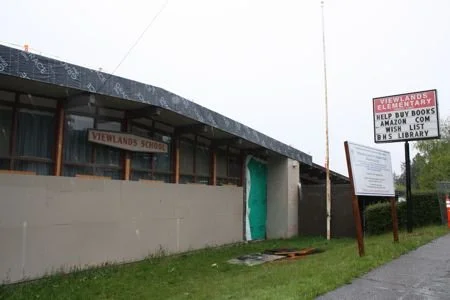
The old Viewlands Elementary during its closed years. [Photo is from to the My Ballard blog.]
And remember what happened to Viewlands Elementary? Danny Westneat recalled in a Seattle Times column in 2024:
The board voted to close [Viewlands] in 2007, but then whipsawed and voted to reopen it just two years later.
Fine, except while it was closed it had been ransacked, with thieves stripping much of its copper wiring. The cost to reopen totaled $10 million — many times more than had been saved by closing it.
Transparency of reasoning, attention to the details, and accountability to the stated plan: Those are going to be the name of the game here, friends.
***
Leaving aside long-term considerations for a moment, I also encourage communities to push SPS for concrete commitments for their buildings in the years immediately following a closure.
For example: Will SPS commit to keeping the playgrounds unlocked and accessible for public use?
This seems like a straightforward enough promise for SPS to make and keep. I’m sure there are SPS lawyers, though, who’d prefer not to open SPS up to the liabilities involved.
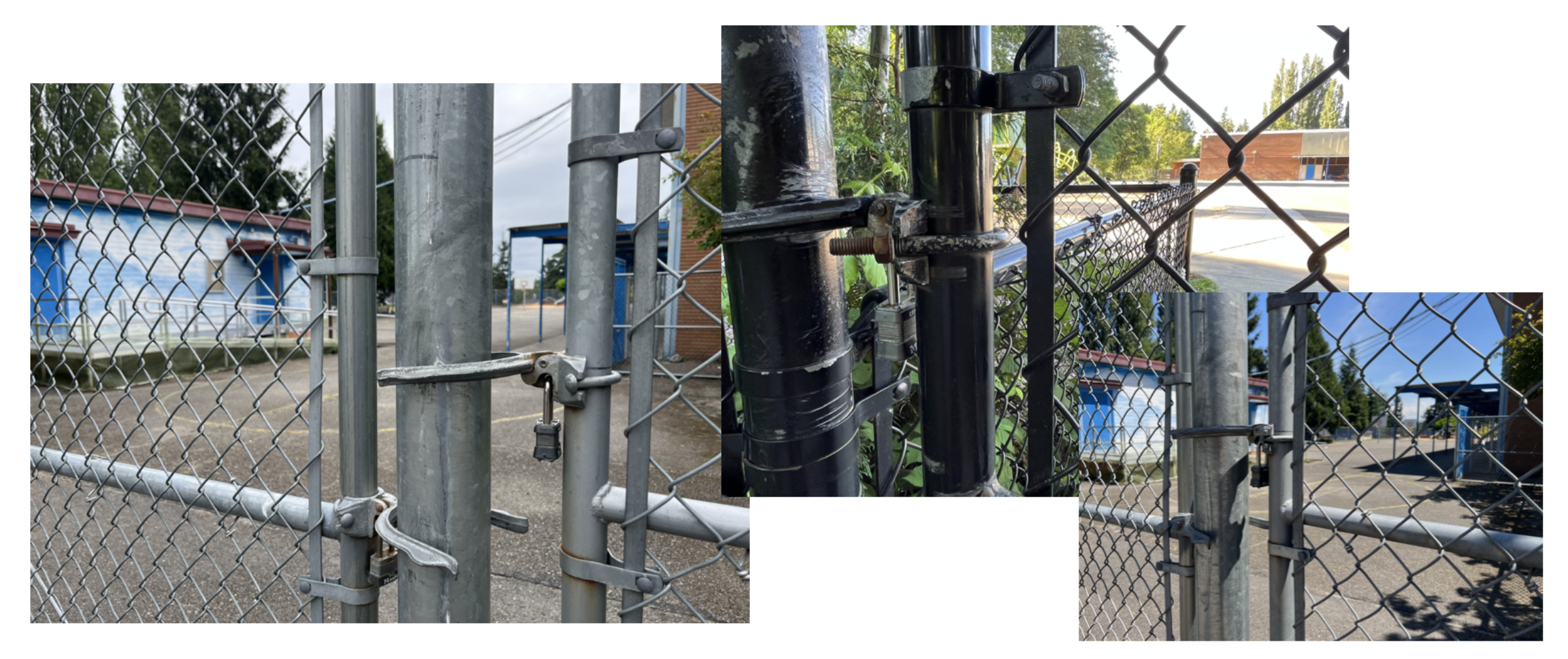
Photos of the playgrounds at Sacajawea Elementary locked against public access. The photos were taken on weekends and evenings when the areas should have been accessible to the public. This is not a long term future I want for any Seattle neighborhood. [Photos by Julie]
What will happen when a kid is injured? What happens when playground equipment requires maintenance or replacement? Putting these together, what happens when a kid is injured on equipment that wasn’t properly maintained?
You can see how the issue of playground use might become complicated. Lawyers are likely to advise SPS leadership that it’s safer to simply close these areas off to public access–and that’s probably true! It’s up to us to represent the other side: The public value of keeping grounds accessible.
Will SPS commit to periodic trash removal from the grounds of any closed sites? Or will we instead find out how many old sofas can fit underneath a swingset?
When a closed building is first vandalized, how will these agreements change? What happens when graffiti pops up on the walls? When a window is broken? When someone sets off fireworks in the parking lot?
What happens when a community garden pops up in the corner of the playground? What if it’s a community of tents instead?
My point here is that it is easy—and superficially free—for SPS leadership to announce that school grounds will remain publicly accessible. I do believe that leadership wants this for our communities. They aren’t villains. But the reality is complicated. The more that SPS leadership can address the nuance of costs and liabilities up front, the more the public will be able to trust their message.
Finally, to repeat myself: The costs of holding up promises about future property use have to square with the budgetary savings gained from closures. There is a natural tension between these two goals, and any trustworthy narrative must balance them.
***
This post is part of a series focused on evaluating SPS closure proposals. The entire series includes: