Before Closures: What Happens to Families?
This post is part of a series focused on evaluating SPS closure proposals.
In the short term, the urgent question for families is what school they’ll be assigned to if their school is closed. For the longer term, the entire city should be asking what kind of boundary changes and long-term facilities planning SPS is going to put in place to create stable, cohesive communities for the long haul.
Especially in newly created school deserts.
Shuldiner appears to be planning for the merger version of closures in 2026. That’s what SPS proposed in 2024 as well.
In the merger model, the staff and students of a closed school are merged wholesale into another school in the region.
Mergers are not the only way to close schools, though. The obvious alternative is to rezone so that families and geographies displaced in a closure end up at schools that make sense for their neighborhoods.
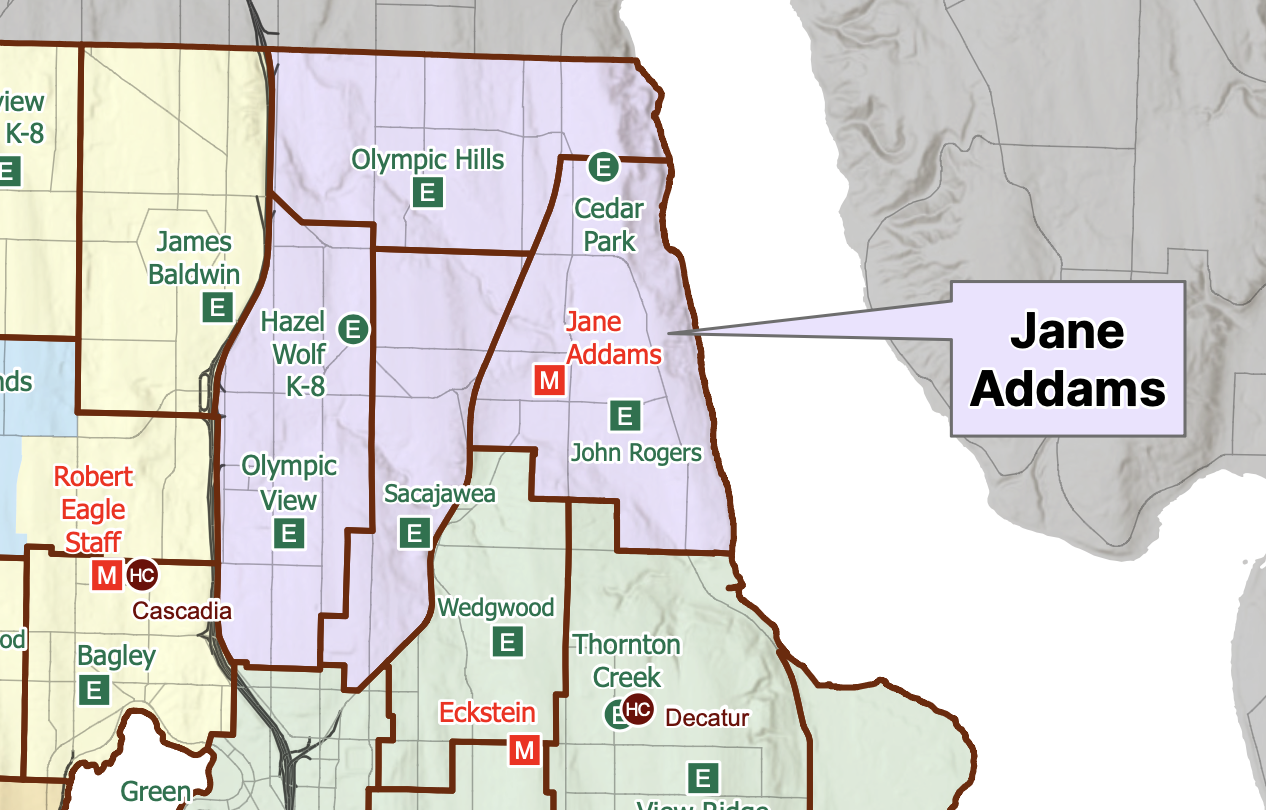
SPS elementary school boundaries in the Northeast corner of Seattle. When closing a school like Sacajawea, rezoning is a requirement for long-term regional stability.
A merger of the Sacajawea and John Rogers zones, as SPS proposed in 2024, makes no sense. There is not a single address in Sacajawea’s geo zone for whom John Rogers is the closest school for elementary services. For families like mine, John Rogers is farther away than four other schools offering K-5 services!
The crummy version of rezoning looks like carving the geo zone of a closed school up into pieces and gluing them to adjacent zones. Mergers are just an extreme version of this.
The sustainable version of rezoning involves redrawing the boundaries for all schools in the region. If upcoming closure announcements touch multiple regions in the city, I’d argue that a citywide rezoning exercise is the best way to handle closure displacements. After all, SPS school boundaries haven’t been meaningfully updated since 2013.
Comprehensive rezoning sounds disruptive, but it needn’t be. It’s common practice to grandfather in families who are already in the system. If you live on a street that is rezoned, your family has the choice to remain at your current school. Families entering kindergarten the following year, or who move onto the street midyear, are assigned according to the updated zoning.
***
Regardless of what form rezoning might take (or not), there’s one easy mitigation that displaced families can advocate for: Displaced families should have the right to choose the school they land in.
Family choice is inconsistent with a merger model, and that’s a problem if Shuldiner is committed to mergers. Family choice is consistent with the massive expansion of the choice program that SPS introduced this spring, though.
I think this is a mitigation that families have a good chance of winning. My experience at Sacajawea indicates that offering families priority choice would significantly reduce community opposition to closures. It would certainly be an easy way for the district to work toward its promise of working with communities, instead of bringing closure decisions down by fiat.
Perhaps more relevantly, this year’s newly expanded choice model is an already-available tool that unhappily merged folks will certainly use next year. The personal choices of displaced families are something the district will end up dealing with one way or the other. I’d advise them to take the option that buys public goodwill by offering the choice up front.
A final note on choice: Special education students are more limited than others in where they can attend school (the services required by these students are not offered at every school). This is already frustrating for them. Consider, too, that many of these students have a more-difficult-than-average time managing change. For these reasons and more, displaced special ed students deserve priority placement in a new school that they can rely on for the long term.
***
This is the last piece in this series. Thank you to everyone who’s read this far, to everyone who advocated for district transparency in the 2024 closures, and to everyone who is preparing to do so again in 2026.
SPS leadership is significantly different now than it was in 2024. We have a new superintendent who is showing up, listening, and leading. The board composition has changed, and their work has become more pragmatic.
For some of my thoughts on how to hold SPS leadership accountable in a closure situation, read here. I wrote this piece specifically for the Sacajawea community, but the ideas generalize easily.
We have every reason to expect that closure proposals rolled out in 2026 might be prepared and shared differently.
Let’s hope I’m right, and let’s be prepared if I’m wrong.
See you out there!
***
This post is part of a series focused on evaluating SPS closure proposals. The entire series includes: