Before Closures: What are the Savings?
This post is part of a series focused on evaluating SPS closure proposals.
School closure proposals are always introduced in the context of budget crises. That’s because it is accepted as common sense that closures save money. Superintendent Shuldiner reinforced this assumption just last week, pivoting smoothly from a discussion of the budget deficit into the benefits of closures with both KOMO and King5 news.
But is this narrative true? Do school closures save significant money?
***
First, the basics: Research does not support the idea that school closures save money. This is a finding that has been rediscovered over and over. It was demonstrated through research as far back as 2013, and as recently as last year and again a few months ago. Heck, NPR aired a segment questioning the cost benefits of school closures just last week!
Look up “school closure savings” or similar on your favorite search engine and browse the results for yourself. You don’t have to trust me on this one.
Sure, you say, but maybe the circumstances at SPS, today in 2026, are exceptional. And maybe they are! But maybe—probably—they’re not.
I’ll believe SPS is the exception when I am shown clear, compelling evidence that the math works out differently for us. Until then, it’s much safer for us to assume we’re the norm. Seattle is not Lake Wobegone.
Chicago closed 46 schools in 2013. Five years later, their finances were worse than before the closures. Our neighbors in Bellevue closed two schools in 2023, hoping to stem their budget crisis. Two years later, in 2025, they entered binding conditions (the school district version of bankruptcy). Closures do not prevent insolvency because they don’t save money.
***
Research aside, I understand how the public and even school administrators fall for the idea that closures save money. After all, if my neighbor who owns a cabin in the mountains falls on hard times, selling his cabin is a no-brainer. It’s a reasonable way for him to cut expenses and access a one-time windfall.
But schools don’t work like homes.
Labor
Fully 81% percent of SPS’s 2026-27 budget is dedicated to staffing costs. The cost of teachers does not change just because they are shuffled between buildings. Imagine that my neighbor’s cabin is housing half of his family, and that food and clothes are 81% of his costs. Shuttering or selling his cabin does not mean he stops feeding and clothing half of his kids!
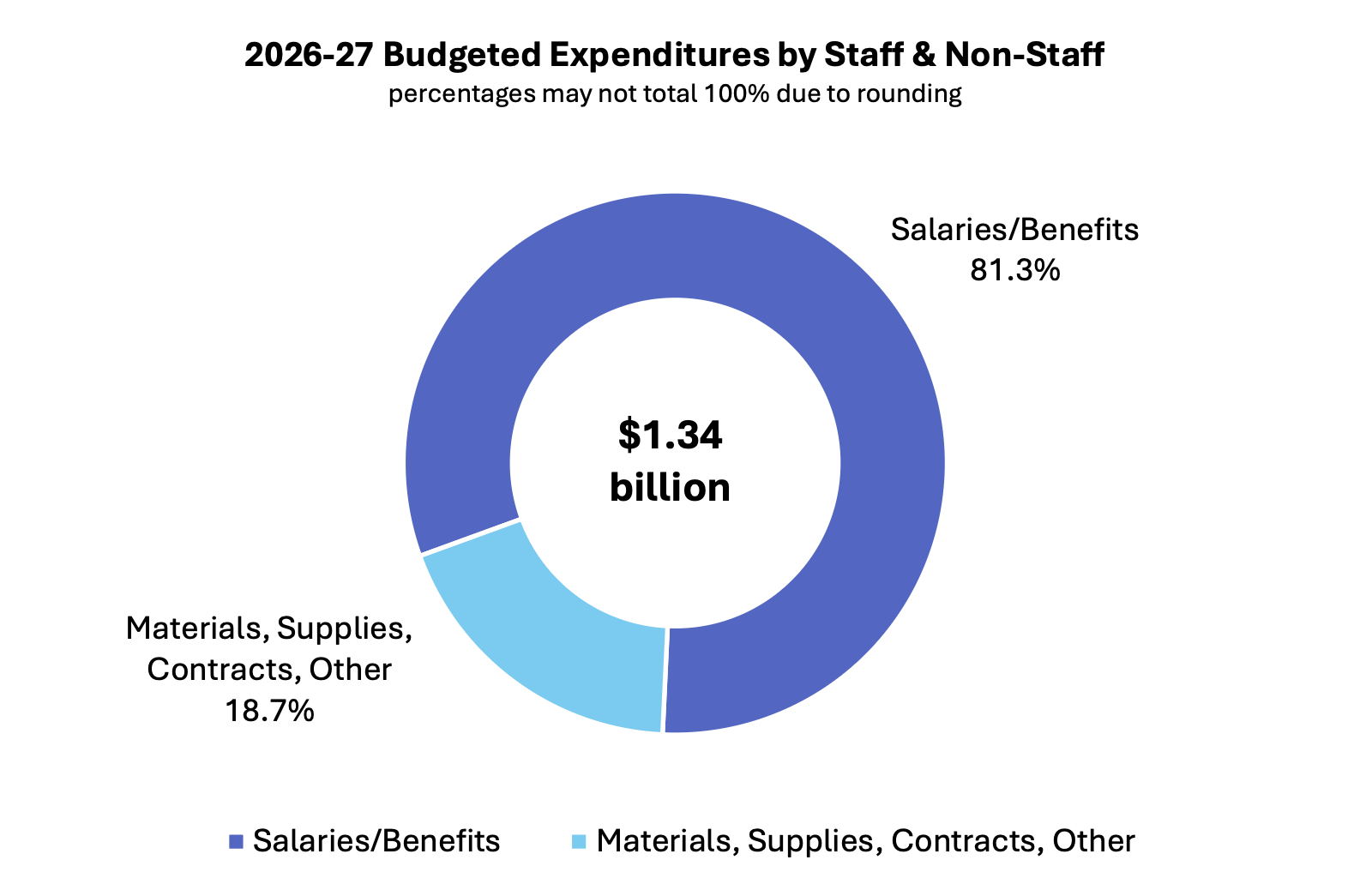
A graphic from the 2026-27 SPS budget. Labor costs (salaries and benefits) account for 81.3% of the $1.34 billion budget.
It is true that closures can generate marginal staffing savings on the administrative side. Every SPS school has one principal, for example, whether it serves 200 or 1,200 kids. Merging together two schools cuts a principal position. The same idea holds for a few other full-time, per-school positions like front desk staff and kitchen managers.
The reduction of this administrative overhead is the only feature of a closure that saves appreciable money. Those savings do not add up to anything close to millions of dollars per school.
SPS elementary principal salaries hovered around $200,000 last year. Secretarial, custodial, kitchen, and other positions come in much lower than that. At Sacajawea, in my neighborhood, the pay for these positions ranges from $27,000 to $63,000 a year.
It’s not uncommon for closure proposals to also include staff cuts beyond the reduction of administrative overhead, but make no mistake: Those cuts yield savings that have nothing to do with the closure. The one can be done without the other.
Transportation
Transportation savings depend significantly on the context of the closed school, and in many cases they are negative. That is, closures can often increase transportation costs.
Closures that displace students out of their walkable neighborhood schools and into more distant buildings increase transportation costs. That’s because they require SPS to provide buses for students who used to walk, which is most of them. Conversely, closures that move currently-bused students from far-flung sites into neighborhood schools might indeed reduce costs.
Mergers usually displace student populations in a way that increases required busing, unless the merged schools are co-located. That displacement is expensive.
Now, it’s true that the state reimburses SPS for transportation costs. In theory, at least, it’s the state and not SPS that would bear the burden of those increased costs. That said, would you like to guess what is one of the top two categories of spending driving SPS’s current deficit?
It’s transportation.
In 2024-25, SPS spent $60.4 million on transportation, while receiving only about $40 million in state transportation funding. That gap alone accounts for $20 million of the district’s $20-$40 million structural deficit.
The impacts of closures on transportation spending must be accounted for in any closure proposal that can be trusted. The details of the school(s) matter here: Who uses a bus today? Who will need a bus after the closure? What new routes need to be created? How will the state reimbursements change? And so on.
In 2024, SPS estimated that each closed school would save between $200,000 and $500,000 in transportation costs. If those savings turn out to be expenditures instead, that delusion is the difference between a plan that reduces the deficit and one that blows a hole in it.
Maintenance & Security
Then there are the maintenance and security costs for the closed buildings.
When my neighbor sells his cabin, he’s no longer responsible for any of its costs.
When districts close schools, it’s rare for them to actually sell the property. More commonly they retain it, in which case they still have to pay to trim the hedges, remove errant trash, etc. The district also has to continue heating closed buildings to keep them in functional condition.
Most importantly, they have to make sure that the sites aren’t vandalized or used informally in ways that harm neighborhoods. This requires lighting and security, and those cost money.
Sometimes districts retain abandoned properties but don’t pay for any maintenance or security. That creates its own, separate problem, of course.
Two Pots of Money
Finally, it’s important to remember that SPS is operating with two different budgets. There’s the operating budget (staff salaries, transportation, teaching supplies, etc.). That covers day-to-day expenses and that’s where the deficit is. And there’s the capital budget, which covers construction, renovations & repairs.
Property sale or lease/rental proceeds, as well as some maintenance expenses, accrue to the capital budget. The one exception is that these proceeds can be put into the general fund if they are earmarked for property maintenance. Overwhelmingly, though, they don’t affect the operating budget—or its deficit—no matter how much money they bring in.
I’ll repeat: Income from the sale or lease of a closed school property does not substantially affect SPS’s structural deficit. It flows into an entirely separate budget that is already quite healthy because taxpayers have been generous in approving our capital levies (rock on, Seattle!).
***
With all of these details in mind, take a look at the slide that Shuldiner shared with the board in June:
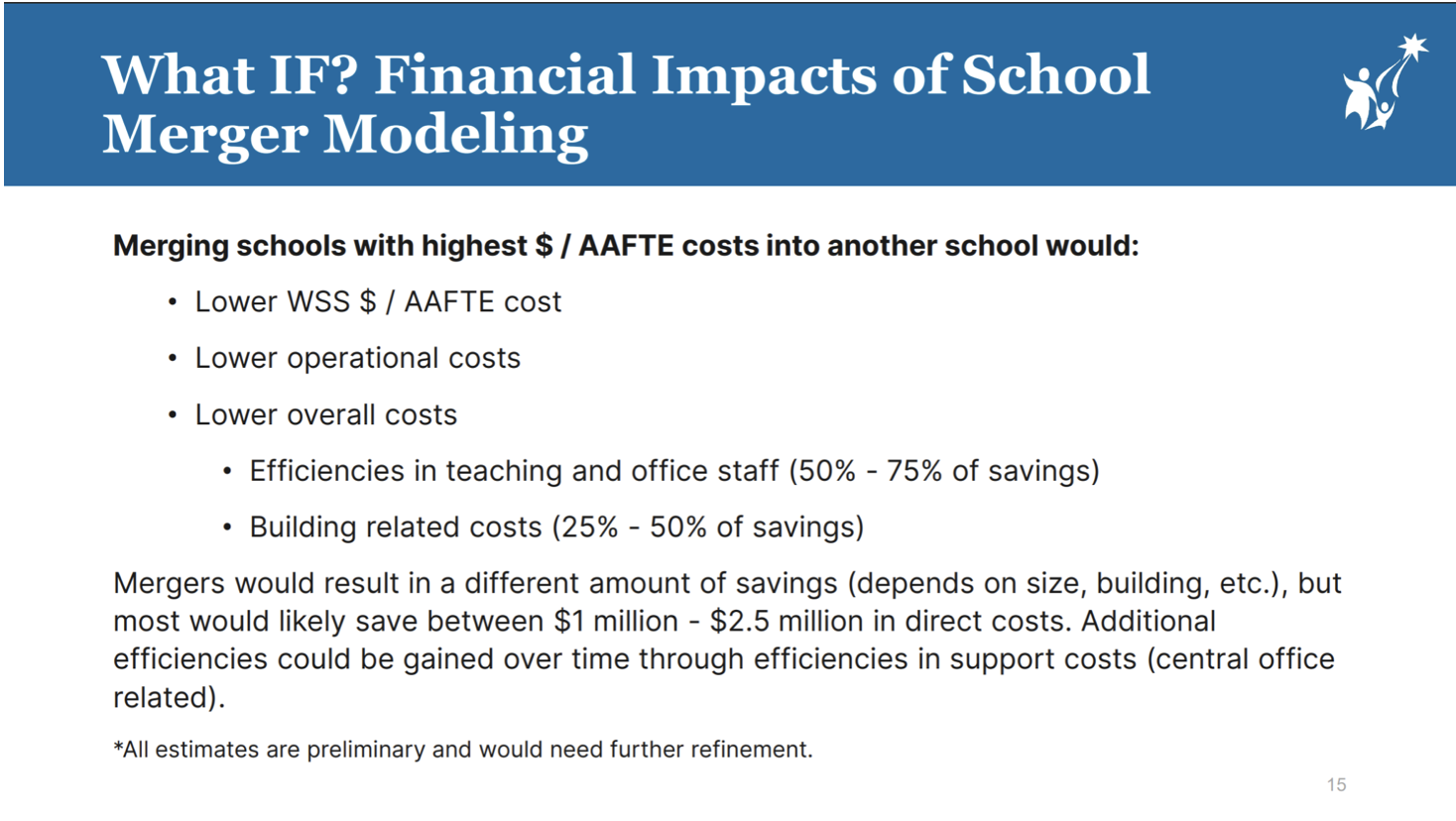
An SPS slide from a June 2026 board meeting. The district estimates savings of $1 million to $2.5 million per school closure (merger). Without understanding how the district arrived at these numbers, it’s difficult to trust in their accuracy.
Are Shuldiner’s estimates correct? I can’t say. You can’t say. The board can’t say.
Without understanding the details of how the district reached these numbers, nobody can say whether they’re accurate. National closure histories over the past 15 years would indicate that the numbers on this slide overestimate savings. Just like SPS did in 2024.
It’s up to the district to show their work. It’s up to the board to hold Shuldiner accountable to that. And it’s up to us to hold the board accountable.
If there’s an aspect of closure finances that I’m overlooking, I’d welcome hearing about it! hello@julieletchner.com.
I’ll leave you with a reference sheet. To evaluate the financial viability of closure proposals, we need to understand:
Are savings estimates based on the specific circumstances of each of the school sites involved?
Which budget (operating budget or capital budget) do each of the costs or savings accrue to?
What savings come from staff cuts?
Which staff cuts are only possible with a closure vs. could be done without one?
Which savings are one-time vs. recurring?
Where do the following categories of costs show up in the analysis:
Salary costs (including teachers, specialists, custodial, nurses, tutors, front office, principals, etc.)
Property maintenance costs
Transportation costs (including regular bussing, special ed bussing, and McKinney-Vento accommodations)
The one-time administrative and material costs of shuttering a building
Costs associated with changed demographics at the merged or accepting schools. Do any gain or lose Title I funding, for example? What about city or community programs and grants?
Costs/savings associated with specific programs. Special ed students, for example, are limited in their choice of schools. Has this been accounted for? If there is a pre-K on site, what’s the cost of relocating it? Etc.
***
This post is part of a series focused on evaluating SPS closure proposals. The entire series includes: