The standardization of SPS schedules this fall has revived conversations about recess time. The conversation has been happening at The Bulletin, on Reddit, and among parents in the play yards. Most recently, Jesse Hagopian spoke out on Wednesday in an op-ed in the Seattle Times.
Like Jesse, many of the voices weighing in about recess are unhappy. They argue that the reductions—which affected roughly one-quarter of SPS schools—are a move in the wrong direction.
In a vacuum, I’d agree. Recess obviously provides all of the benefits that Hagopian and others cite. That’s why WA state law, district policy, and this year’s SPS elementary schedules protect 30 minutes of daily recess.
But we aren’t in a vacuum. Here’s the elephant in the room: Reading proficiency among SPS elementary schoolers has been in a slump since Covid. And it’s only getting worse: Third grade reading scores dropped by two percentage points over the past two years, landing the district at its lowest point since at least 2018.*
Something has to change.
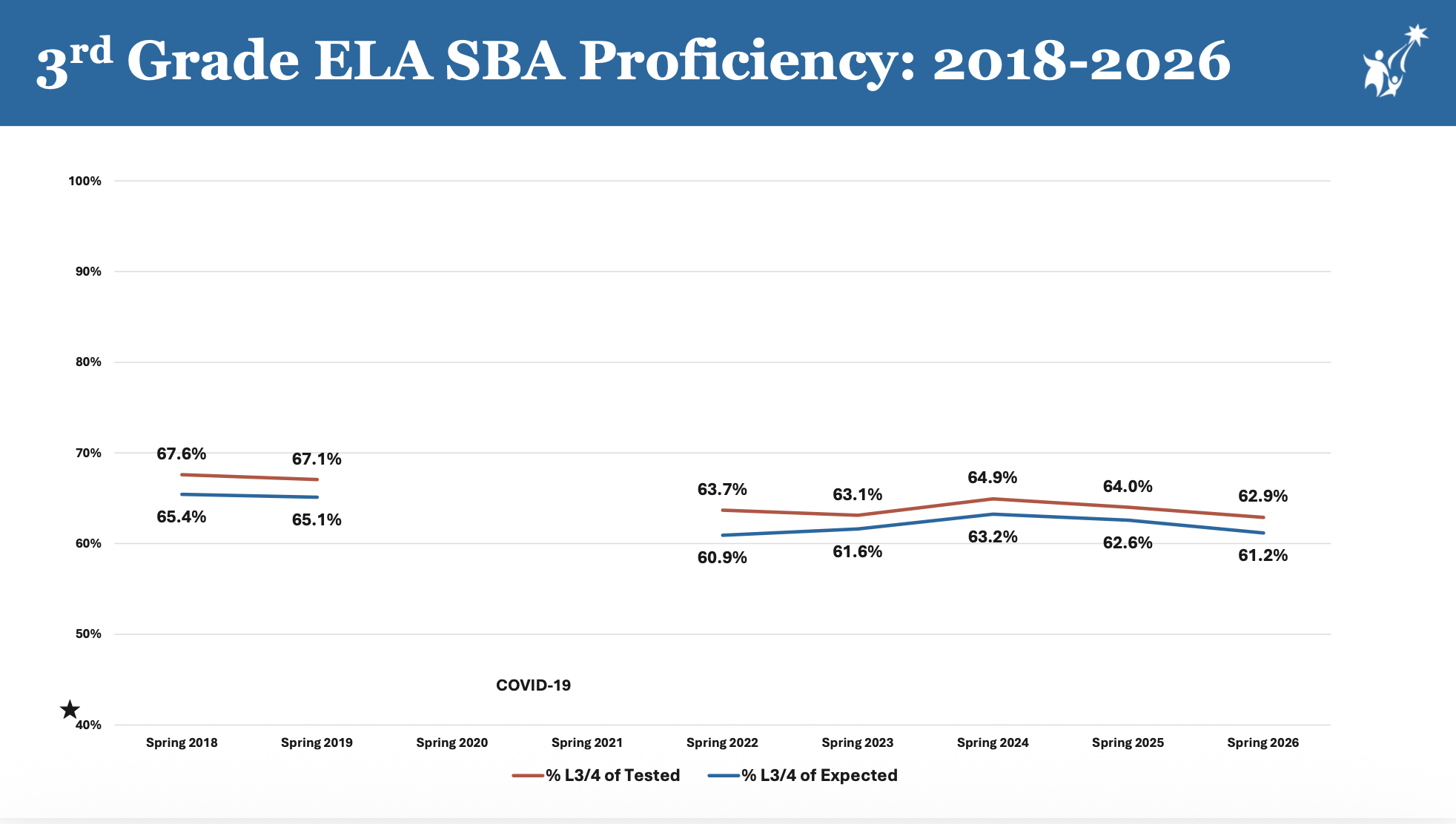
SPS slide from Oct 21, 2026. Third grade ELA scores are the lowest they’ve been since at least 2018. The red line is the more accurate measure and is the metric that SPS and Washington state use today.
There is hope. Finally—finally!—the district is actually making changes.
This year’s standardization of recess times is not a one-off decision, but rather a small piece of a larger shift. The shift includes a new K-5 ELA curriculum, reorganized teacher supports, standardized blocks for ELA, math, science, and social studies, and, yes, 30 minutes of daily recess.
The new ELA curriculum in particular is known for being strong on foundational skills (think more phonics, less guessing). It requires 120 minutes of instructional time daily. That’s part of why some formerly flexible schools no longer provide additional recess.
This is a new direction I’m excited to explore.
The best outcome would be improved literacy for Seattle’s kids in the coming 2-3 years. If that happens, then perhaps the district could experiment with ideas for adding flexibility back into schedules. Some schools might choose to provide additional recess, but others may well choose to stick with a system that is working to educate more students.
A less good outcome would be stagnation, or even a further decline, in reading. If that’s the reality then obviously it will be time to try something different. That would be tragic, but the district will at least have learned something (and maybe that something will be that more recess is critical).
The very worst outcome would be for the district to go back to what they’ve been doing in recent years. That would be both tragic and useless. We already know what wasn’t working.
***
It’s not just that SPS’s recent tactics haven’t worked. It’s that they’ve failed some groups far more than others.
Hagopian’s op ed raises very real equity concerns. He cites racial disparities between the average amount of recess received in SPS in 2019 by white kindergarteners (45 minutes) vs. Black kindergarteners (30 minutes), and writes, “The language of equity is being weaponized to justify taking recess away from children rather than expanding it for all.”
The equity conversation is incomplete unless it also includes the racial disparities in learning outcomes. In 2025, only 30.9% of Black third graders at SPS were proficient in ELA (the district average was 62.6%). White student proficiency was at 76.3%, revealing a 45-point racial gap.
Our Black students, like students in other populations facing opportunity gaps, deserve to learn. I can’t say for sure whether the new curriculum and standardized recess will start to close this gap for them. I can say with certainty that the status quo was failing them. It was failing them on literacy, and it was also failing them on additional recess, per Hagopian’s statistics.
I am not suggesting that higher test scores are the only goal here. The goal is a robust and supportive education for every student.
A child is not the sum of their test scores, but a child who cannot read is a child who has been failed by their school. A system consistently reproducing a 45-point gap between its white and its Black students is a system that is unambiguously failing its Black students.
It’s time to try something different.
***
Recess and reading are not actually in opposition. There is a version of elementary scheduling where kids get abundant recess and 120 minutes of rigorous ELA instruction time. It’s even possible that that combination would boost kids’ reading even further. Doing this would also mean less of something else, though. Should the district reduce math instruction to get there? Music? Social-emotional learning? The Native-focused social studies curriculum? Lunch?
As with all problems worth discussing, there is no simple answer here. Something has to change, though, and I think that the changes that Superintendent Shuldiner has introduced this year are as good a place to start as any.
Literacy as an elementary school priority makes sense to me. Recess is reduced (for some), but everyone still gets 30 minutes daily—sometimes more, if they’re granted a waiver. Students retain access to the same wide range of other important programs.
Hagopian’s op ed includes a charming anecdote about Thurgood Marshall fifth graders writing critically in their student paper about the reduction in recess. I love this. It’s educational, civically engaged, timely, and personal.
I am left wondering how many fifth graders across the district have sufficient writing skills to contribute to a school newspaper. How many of our third graders have the ability to read one?
I’d like SPS to become a district where every fifth grader learns to express their opinions clearly. I’m confident that recess advocates want this as well. I hope the district doesn’t let the perfect be the enemy of the good here.
SPS is overdue for a shift in its approach to elementary literacy. The changes being implemented this year are imperfect but more promising than anything we’ve seen in a long time. Let’s see where this new direction can take our kids.
~
*The SPS literacy data in this article is taken from this deck presented to the school board on October 21, 2026 (pages 16-18).